
AI-Kit · Architecture
Deploy an AI Backend for WordPress Without Giving Up Control
On-device AI is a strong default, but it is not the answer for every browser, workload, or knowledge-driven experience. AI-Kit adds an optional backend path that can run in the customer’s own AWS account, giving WordPress teams a controlled fallback and a foundation for grounded chatbot and DocSearch features.
The architecture
Add a backend for specific requirements, not because every AI feature needs one.
Local-first remains available
Supported browser workflows can continue to run on the device without sending ordinary editing tasks to a remote model.
AWS handles the runtime
API routes, serverless compute, storage, retrieval, and model access can be deployed into the customer’s AWS account.
WordPress stays the control surface
Editors manage content and knowledge sources in WordPress while the backend performs protected processing and retrieval.
01 · Decision
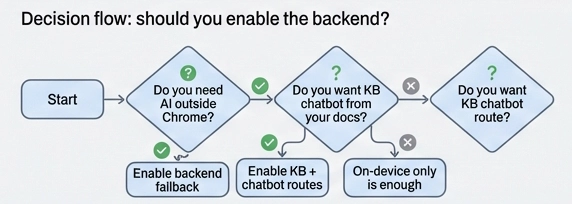
When does a WordPress site need an AI backend?
A backend becomes useful when browser support must be broader, requests are too heavy or long-running for the on-device path, or visitors need consistent behavior across devices. It is also required when the answer should be grounded in managed documentation rather than generated from general model knowledge.
Not every site needs this layer. A small editorial site may be well served by local tools alone, while a documentation portal or customer-facing assistant usually benefits from a reliable protected runtime.
- Choose fallback when local execution should remain the preferred path.
- Choose backend-only when consistency matters more than device-local processing.
- Add retrieval when answers must be tied to approved source content.
The right design is the smallest architecture that satisfies the actual workflow and governance requirements.
02 · Ownership
What does customer-owned AWS change?
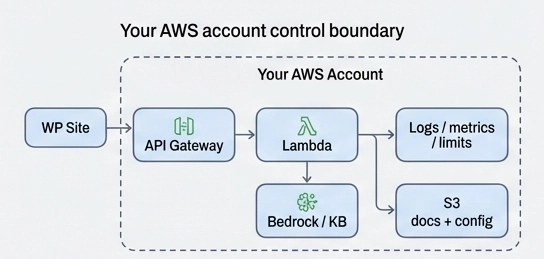
The backend is deployed into an AWS account controlled by the customer. That account owns the infrastructure, storage, service configuration, access policies, operational logs, and AWS usage charges.
WP Suite supplies the WordPress integration and deployment path, but it does not turn the customer’s backend into an opaque shared AI SaaS environment. This makes the technical and billing boundary easier to explain to agencies and enterprise customers.
- Documents and configuration can remain in customer-controlled storage.
- Authentication and public exposure can be selected per route.
- AWS service costs remain visible in the account where the stack runs.
Customer ownership does not remove the need for security design, monitoring, and retention decisions; it gives the customer the place and tools to make them.
03 · Components
What capabilities belong in the backend layer?
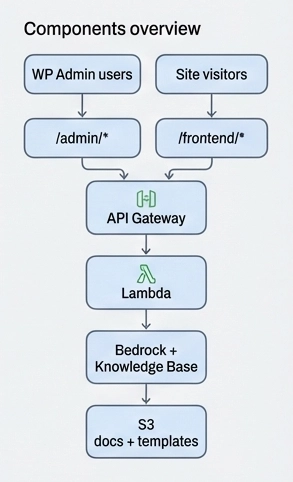
A typical AI-Kit backend combines protected API endpoints, Lambda-based processing, configuration and document storage in S3, model access through Amazon Bedrock, and optional retrieval components for knowledge-grounded responses.
Admin routes and visitor-facing routes should not automatically share the same authorization model. Editor operations may use Cognito or IAM, while a public chatbot route may combine limited functionality with reCAPTCHA, rate controls, and a carefully constrained prompt policy.
- Separate admin and frontend API responsibilities.
- Keep prompt, policy, and retrieval configuration explicit and reviewable.
- Expose only the operations that the frontend experience actually needs.
This reduces the chance that a convenient public endpoint becomes a general-purpose AI proxy.
04 · Knowledge base
How do WordPress documents become grounded answers?
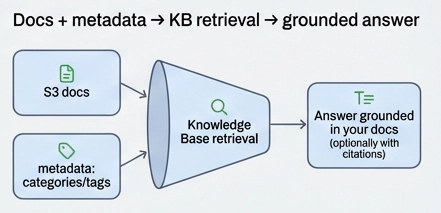
AI-Kit can manage knowledge-base sources from WordPress, generate backend-ready documents, and publish approved content into the configured retrieval workflow. KB Section controls can exclude content, split a page into separate sources, or preserve an intentionally overridden section.
At query time, DocSearch or chatbot requests retrieve relevant source material and provide that context to the response process. Citations and source-aware UI help the visitor distinguish grounded content from an unsupported answer.
- Curate the source set instead of ingesting every page blindly.
- Use categories, tags, and section boundaries where they improve retrieval.
- Review regenerated documents when source pages change.
Retrieval quality depends as much on source structure and governance as it does on the model.
Control boundary
Owning the AWS account is a foundation, not a complete policy.
Define who may change prompts, publish knowledge sources, inspect logs, alter API exposure, and manage model access. Infrastructure ownership is most valuable when the operating responsibilities are equally clear.
Next step
Map the backend requirements before you deploy.
Review the AI-Kit product and architecture material, then use Deployment Access when the project is ready for guided customer-account infrastructure.